
№ 010Account standing11 minTal Weiss
Reused content rules on YouTube, TikTok and Instagram
YouTube reused content, TikTok unoriginal content and Instagram originality rules, quoted from each platform: what triggers them and what they cost.
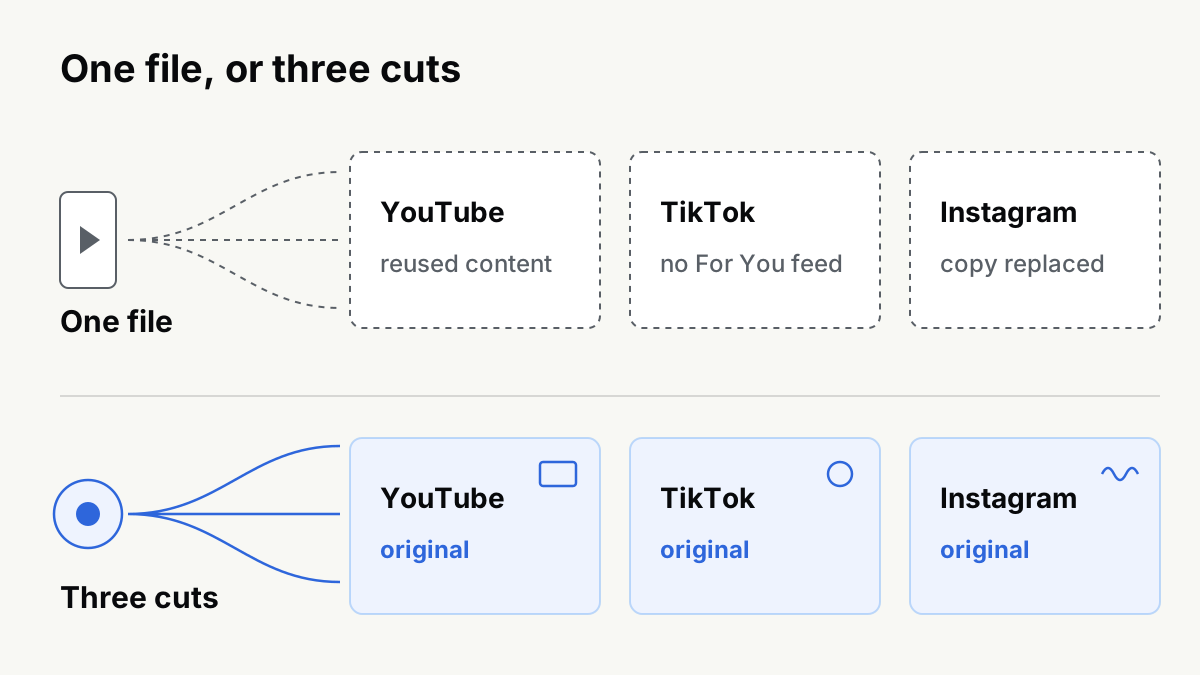
Short answer. Three platforms enforce originality at the account level, and all three published their rules in plain language. YouTube judges reused content across the whole channel and can remove monetisation from all of it; on 2025-07-15 it renamed its repetitious-content policy to inauthentic content to cover mass production. TikTok makes reused material ineligible for the For You feed rather than removing it. Instagram replaces the copy with the original in recommendations, and drops an account out of recommendations entirely at 10 or more copies in 30 days. The shared test is transformation a viewer can see. Everything below was pulled from the platforms' own pages on 2026-09-21.
- 10 in 30 days
- copies before Instagram stops recommending an account
- Instagram creators blog, 2024-04-30
- 21 days
- to appeal a YouTube monetisation suspension
- YouTube Help, Monetization is disabled
- 90 days
- before a suspended channel can re-apply to YPP
- YouTube Help, Monetization is disabled
- 2025-07-15
- YouTube renamed repetitious to inauthentic content
- YouTube channel monetization policies
The three rules in one table
| Platform | Policy name | What triggers it | What it costs | Recovery | Source (retrieved 2026-09-21) |
|---|---|---|---|---|---|
| YouTube | Reused content | Repurposing content from YouTube or elsewhere without significant original commentary, substantive modification or added value | Monetisation removed from the entire channel | Appeal within 21 days, or re-apply to YPP 90 days after suspension | Channel monetization policies |
| YouTube | Inauthentic content (renamed from repetitious, 2025-07-15) | Templated, mass-produced or interchangeable videos, including AI made from generic templates | Ineligible for monetisation | Same ladder as above | Channel monetization policies |
| TikTok | Unoriginal Content and IP Rights | Reused material "without anything new"; another app's watermark; clips made from GIFs only | Ineligible for the For You feed; ineligible for Creator Rewards | Strikes expire 90 days after issue; account standing may be restored automatically | Integrity and Authenticity |
| Originality and Recommendations Guidelines | Identical copies of existing content; unoriginal content "largely repurposed ... with only minor, immaterial edits" | Copy replaced by the original in recommendations; account dropped from recommendations at 10+ copies in 30 days | Rolling: eligible again on dropping below the threshold; appeal in Account Status | Helping Creators Find New Audiences |
YouTube: two policies, and both judge the channel
The rename is the news most people missed. From the changelog at the top of the monetisation policies page:
July 15, 2025: We're making a minor update to our "repetitious content" policy to better clarify this includes content that is repetitive or mass-produced. We are also renaming this policy from "repetitious content" to "inauthentic content." This type of content has always been ineligible for monetization under our existing policies ... There is no change to our reused content policy which reviews content like commentary, clips, compilations, and reaction videos.
So there are two policies, not one, and they catch different failures. Inauthentic content catches sameness; reused content catches provenance.
The inauthentic list is unusually specific about AI:
Similar or repetitive content with low educational value, commentary, narratives, or minimal variation across videos. Videos where characters are put in the same situation over and over again with the same outcome. Image slideshows, templated storylines, or scrolling text with minimal or no narrative, commentary, or educational value. AI-generated content made with generic or unoriginal templates giving the impression of mass production without adding the creator's original, authentic insights or perspective.
Reused content is defined separately, and the scope is the sentence to remember: "Our reused content policy applies to your channel as a whole. If you have videos that violate our guidelines, or if we cannot clearly tell that you made the content, monetization may be removed from your entire channel."
Two items on its not-allowed list are aimed squarely at the automated news format: "Content that exclusively features readings of other materials you did not originally create, like text from websites or news feeds", and "Content downloaded or copied from another online source without any substantive modifications". A third policy in the same set, Unsatisfying or Off-putting Content, covers work that "mimics existing formats or stories to a degree that the videos feel interchangeable".
One more line that catches people who did everything else right: "This policy applies even if you have permission from the original creator. Reused content is separate from YouTube's Copyright enforcement, which means it's not based on copyright, permission, or fair use."
Recovery is the most documented of the three, and the numbers are exact (Monetization is disabled for my channel, retrieved 2026-09-21). If YouTube warns you that your channel is scheduled for suspension, you have 7 days to submit a video appeal and it responds within 14 days. If you are suspended, you can appeal within 21 days, or re-apply 90 days after the suspension date, and a re-application review "takes about a month". Where the problem is Community Guidelines or copyright strikes instead, monetisation may be reinstated "after 3 months" with no new issues in that window.
TikTok: ineligible, not removed
TikTok does not take reused video down. It stops recommending it, which on a platform whose product is the For You feed is close to the same thing. The guideline is one sentence, with two examples under it:
Content is also ineligible for the FYF if it includes unoriginal or reused material without anything new.
FYF INELIGIBLE: Reused or unoriginal content posted without creative edits, such as clips that show someone else's watermark or logo. Low-quality or minimally edited content, such as short clips made from GIFs only.
The Creator Academy expands that into four named shapes: content copied outright, content "largely repurposed from another source without adding any creative edits" (its examples are adding subtitles from the original audio, or basic text summaries over someone else's clip), content "combined from multiple sources with little or no additional information or content value" (its example is "Only splicing clips together"), and anything carrying a visible watermark from another app (Understanding TikTok's Originality Policy, last updated 2025-12-23, retrieved 2026-09-21).
The money consequence is on the same page: "Unoriginal content is also ineligible for TikTok's monetization programs like the Creator Rewards Program, which uses 'originality' as a key metric in its rewards formula."
Where to look: TikTok points you at Account Check for the originality status of your videos, and a per-post decision appears in that post's Analytics with an Appeal button on it. The zero-views version of this diagnosis is in TikTok 0 views on a new account.
Instagram: the copy gets replaced, the aggregator gets dropped
Instagram published the most mechanical version of the rule, in April 2024, and it still reads live today:
First, when we find two or more identical pieces of content on Instagram, we will only recommend the original one. This means that the original content will directly replace the copied version in recommendations.
... accounts that repeatedly (10 or more times in the last 30 days) post content from other Instagram users that they didn't create or enhance in a material way will not be shown in surfaces where we recommend content. These accounts can become eligible for recommendations again only when they drop below the threshold of 10 copies of original content in a 30 day period. This is calculated on a rolling basis and can be checked by using account status where they will also have the option to appeal.
(Helping Creators Find New Audiences, 2024-04-30, retrieved 2026-09-21.)
Ten in thirty days, rolling, self-serve to check, appealable. That is the only hard threshold any of these three platforms publishes, and it is worth knowing precisely because almost nobody writing about Instagram originality quotes it.
The standing rule sits in the Recommendations Guidelines: not recommended is "Content that is low-quality or associated with low-quality publishing, such as: Unoriginal content that is largely repurposed from another source with only minor, immaterial edits, without adding material value" (Recommendations on Instagram, retrieved 2026-09-21). Note also what the eligibility check names as a disqualifier in the same 2024 post: content that "has no visible watermarks". Cross-posting a TikTok export with the TikTok watermark still on it fails that test before anything else is evaluated.
What actually counts as transformation
Put the three allowed-lists next to each other and they converge on one test: can a viewer tell your version apart from the source.
- YouTube allows reused material "if viewers can tell that there's a meaningful difference between the original video and your video", and its examples are clips used for a critical review, reaction videos with your commentary, "Content that primarily features the uploading creator in the video", and edits "where the creator is either visible in the content or explains how the creator added to the content".
- TikTok asks for the same thing in creator language: appear on screen, add your own voice-over, "Provide extra background information and details", and "Reconstruct your material with extra editing that showcases the plot or narrative in a new light."
- Instagram draws the line at "material value" versus "minor, immaterial edits".
Every one of those descriptions is satisfied by a person, visible or audible, doing something the source did not do. None of them is satisfied by a rendering pipeline.
What the AI label does, and what it does not
Both platforms that require an AI label also promise it costs nothing.
TikTok: "Applying the label will not have an impact on the engagement with your content, provided that your content isn't violative and meets our For You feed eligibility standards", and it cannot be edited or removed after posting (AI-generated content label, last updated 2026-04-30, retrieved 2026-09-21).
YouTube: "Note: Disclosing AI content won't limit a video's audience or impact its eligibility to earn money" (Disclosing use of GenAI content, retrieved 2026-09-21). The cost is on the other side: "Creators who consistently choose not to disclose this information may be subject to manual application of a label, or penalties from YouTube, including removal of content or suspension from the YouTube Partner Program." And the label often arrives without you: YouTube applies it automatically to content containing C2PA metadata, and that automatic label cannot be adjusted.
Both also publish exemptions that matter to anyone making video with AI in the pipeline rather than in the frame. YouTube does not require disclosure for "Production assistance, like using generative AI tools to create or improve a video outline, script, thumbnail, title, or infographic", for caption creation, or for "Cloning one's own voice to create voice overs or dubs". TikTok does not require it for "generic text-to-speech (TTS) narration, when the TTS isn't a recognizable voice of a known individual".
Now the part that gets skipped. The label is a disclosure duty. It is not an originality defence, and the two policies are independent. A correctly labelled AI video made from a generic template is still, in YouTube's own words, "AI-generated content made with generic or unoriginal templates giving the impression of mass production". Labelling it does not move it off that list. The label answers "is this synthetic"; the originality rules answer "did you add anything", and only the second one decides whether the channel keeps its money.
What this changes in our own publishing
We are an AI content company, so this is our own risk story, not a hypothetical.
Three rules fall out of the pages above, and we broke two of them ourselves before we had read them this closely. Label AI media at upload, on every platform that has a field for it, and never strip provenance metadata to avoid a label. Never publish the same file twice: one recording, one cut per platform, different opening seconds, no other app's watermark in frame. And put the founder on camera wherever the format allows, because that is the single move every one of the three allowed-lists above names explicitly.
Here is what breaking them looked like. A brand account of ours published three AI-narrated news clips in seventeen hours; eight days later all three were still at 0 plays. Nothing was removed and no strike was issued. Read against the rules in this note, the format was a templated reading of material we did not create, published at volume, from an account with no history, and at least two of those are named in TikTok's and YouTube's lists verbatim. Separately, an identical file we sent to a second account 24 hours after the first came back region-blocked, while the first copy holds 382 plays. That is one export, two uploads, and the second one met the definition of reused material with nothing new added.
Which reader you are
For a founder with one real brand account, this is a production rule, not a compliance problem: record once, cut three times, label the AI, keep yourself in the frame. The originality rules are, unusually, aligned with the thing that works anyway.
For an operator running many accounts, these rules are the constraint, not a nuisance. Instagram's aggregator threshold is counted per account on a 30-day rolling window; YouTube's reused-content judgement is passed on the channel as a whole; TikTok's is passed on the account when enough of its posts are ineligible. Fan-out of one asset is the exact behaviour all three measure, and no amount of infrastructure changes what the file looks like when it lands.
What to do this week
- Search your own library for one file published in two places. That is the cheapest fix available and it is usually sitting there.
- Turn a watermark check into a publishing gate. Another app's logo in frame is named by TikTok and by Instagram as a disqualifier.
- Set the AI disclosure at upload, not after. TikTok's label cannot be changed once posted, and YouTube's automatic C2PA label cannot be adjusted at all.
- If a YouTube channel is already flagged, read the exact dates before acting: 7 days to appeal a scheduled suspension, 21 days to appeal a suspension, 90 days to re-apply.
- Add one thing per cut that the source could not have: your face, your voice, your argument. Every platform's allowed-list is a description of that.
ShapelessAI is an agentic social media team: it researches your market, then writes, designs, and publishes posts and short video to nine platforms.
Questions
- What counts as reused content on YouTube?
- YouTube defines it as channels that repurpose content already on YouTube or another online source without adding significant original commentary, substantive modifications, or educational or entertainment value. It is judged on the channel as a whole, not video by video, and monetisation can be removed from the entire channel. It is also separate from copyright: you can have permission from the original creator and still violate it.
- What is YouTube's inauthentic content policy?
- On 2025-07-15 YouTube renamed its repetitious content policy to inauthentic content, to clarify that it covers content that is repetitive or mass-produced. Its own not-allowed list names AI-generated content made with generic or unoriginal templates giving the impression of mass production without adding the creator's original insights. The reused content policy was unchanged by that rename.
- What is unoriginal content on TikTok?
- TikTok's Community Guidelines make content ineligible for the For You feed if it includes unoriginal or reused material without anything new, and name reused clips showing someone else's watermark or logo, and minimally edited content such as clips made from GIFs only. Unoriginal content is also ineligible for the Creator Rewards Program, which uses originality as a metric in its rewards formula.
- Does Instagram penalise reposting someone else's content?
- Yes, in two ways it published in April 2024. When it finds two or more identical pieces of content, it recommends only the original and replaces the copy. And an account that posts content it did not create or enhance in a material way 10 or more times in 30 days is not shown where Instagram recommends content, on a rolling basis, until it drops back below that threshold.
- Does labelling content as AI-generated protect it?
- It satisfies disclosure and nothing else. TikTok says applying the AI label will not affect engagement provided the content is not violative and meets For You feed standards; YouTube says disclosing AI content will not limit a video's audience or its eligibility to earn money. Neither makes reused or templated material original: YouTube's inauthentic content list names templated AI production directly.