
№ 008Account standing11 minTal Weiss
TikTok 0 views on a new account: what it means and the fix
TikTok 0 views on a new account is one of four states, and only three are penalties. What TikTok's own rules say, and the exact screen that tells you which.

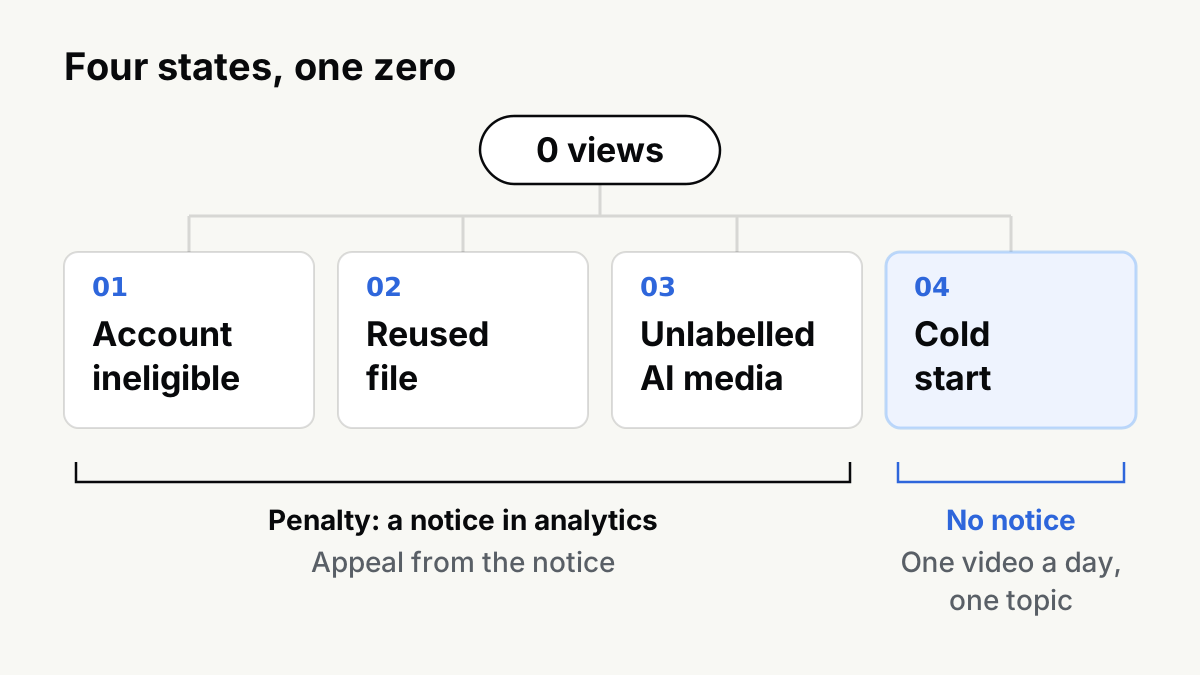
Short answer. Four different states show the same zero, and only three of them are penalties. TikTok's own For You feed standards say it plainly: "If a video isn't getting many views, it also doesn't necessarily mean it broke a rule" (For You feed Eligibility Standards, retrieved 2026-09-21). The three to rule out are an account TikTok has made ineligible for recommendation, a file it has already seen somewhere else, and unlabelled AI media. The fourth is the ordinary cold start, and its fix is one video a day on one topic, not a warm-up ritual.
- 4
- states behind a zero; only 3 are penalties
- TikTok guidelines, read 2026-09-21
- 90 days
- until a TikTok strike expires
- TikTok, Content violations and bans
- 382
- plays on the first copy; the re-upload was blocked
- our own TikTok accounts
- 3 in 17 h
- AI news clips, all at 0 plays
- our own TikTok accounts
Which rules these are
TikTok is mid-swap. The Community Guidelines live today at tiktok.com/community-guidelines/en and carry the line "Released August 14, 2025 • Effective September 13, 2025", with a banner on every page saying "On September 24, 2026, we are updating our Community Guidelines". The new version is already published behind a version switch. We pulled both on 2026-09-21 and diffed them: the Integrity and Authenticity chapter, which holds every rule in this note, is identical in both apart from the release and effective dates. Everything quoted below therefore survives the 24 September swap.
Two more things the guidelines say are worth keeping in view before the diagnosis starts. Not reaching the For You feed is not the same as being invisible: "Even if a video doesn't make it to the FYF, people may still find it through search or by going to a creator's account." And the platform tells you when it has made a decision: "If your content is made ineligible for the FYF or otherwise restricted, this information will appear in the TikTok analytics tool" (Enforcement, retrieved 2026-09-21).
That last sentence is the whole diagnostic. A zero with a notice in analytics is a policy decision. A zero without one is a distribution outcome, and the two need opposite responses.
Check 1: the account itself, not the post
This is the state people mean by shadowban, and TikTok describes it in ordinary words. From the Accounts and Features chapter: "Sometimes, accounts that don't break the rules still post a lot of content that's ineligible for the FYF. In those cases, we may make the account and its content ineligible for the FYF and harder to find" (Accounts and Features, retrieved 2026-09-21).
The help centre repeats it with the consequence attached: "If you repeatedly post content that is unsuitable for the For You feed, your account and posts won't appear in the For You feed and will be harder to find in search" (Why is my account not being recommended?, retrieved 2026-09-21).
Note the mechanism. No single video has to break a rule. A run of individually ineligible posts moves the ineligibility up a level, from the post to the account, and at that point a new upload starts at zero regardless of how good it is. That is the account-level floor under everything else, and it is why a founder who posted ten near-identical clips in a week can look at a good eleventh video and see nothing happen.
That same help page carries the recovery, and it is unusually soft: "We may automatically restore your account to good standing at any time, depending on how much content on your account isn't suitable for the For You feed. Otherwise, you can submit an appeal." The appeal is on the notice itself, under your username on your profile or in your inbox.
Separately, strikes: "Strikes on your TikTok account will expire after 90 days and will no longer be taken into consideration for a permanent account ban", and, on the same page, "Deleting your content does not remove strikes, and we may still issue strikes after you delete violative content" (Content violations and bans, retrieved 2026-09-21). Deleting the flop is the single most common reflex and it buys nothing.
Check 2: has this exact file been published before
The unoriginal-content rule is one sentence in the guidelines and two bullets under it:
Content is also ineligible for the FYF if it includes unoriginal or reused material without anything new.
FYF INELIGIBLE: Reused or unoriginal content posted without creative edits, such as clips that show someone else's watermark or logo. Low-quality or minimally edited content, such as short clips made from GIFs only.
(Integrity and Authenticity, retrieved 2026-09-21.)
The Creator Academy adds the shapes that trip it: content copied from others, content "largely repurposed from another source without adding any creative edits", content "combined from multiple sources with little or no additional information or content value", and anything carrying another app's watermark (Understanding TikTok's Originality Policy, last updated 2025-12-23, retrieved 2026-09-21). A text-to-speech slideshow of clips you did not shoot is the exact centre of that target. So is the same export sent to a second TikTok account.
We cover the cross-platform version of this in reused content rules on YouTube, TikTok and Instagram.
Check 3: AI media, unlabelled
TikTok's rule is narrow and specific: "we require creators to label AI-generated or significantly edited content that shows realistic-looking scenes or people. Unlabeled content may be removed, restricted, or labeled by our team, depending on the harm it could cause" (Integrity and Authenticity, retrieved 2026-09-21).
Two exemptions in the same section matter for anyone publishing AI video. Disclosure is not needed for "small edits like color correction, reframing, or cropping", and it is not needed for "generic text-to-speech (TTS) narration, when the TTS isn't a recognizable voice of a known individual". So an AI voice reading your own script over your own footage is not, by itself, a labelling duty. AI-generated footage of realistic people or places is.
One item on the same page is not a labelling duty at all but a removal one, and it is the trap for anyone making news-shaped video: AIGC "made to look like it comes from a real news source" is listed under NOT ALLOWED, not under FYF INELIGIBLE.
The label itself is set at upload, on the Post screen under More options, and TikTok says it cannot be edited or removed afterwards. It also says what the label does not cost you: "Applying the label will not have an impact on the engagement with your content, provided that your content isn't violative and meets our For You feed eligibility standards" (AI-generated content label, last updated 2026-04-30, retrieved 2026-09-21).

What we see in our own publishing
We run a publishing engine across nine platforms, so we get to watch these rules land on real accounts rather than describe them. Four observations from our own TikTok accounts, all from the last two weeks.
A brand account with one follower published three AI-narrated news clips inside seventeen hours. Eight days later all three sat at 0 plays. Read against the rules above, that account did three flagged things at once: it ran news-shaped AI video without the AIGC label, it published a templated format three times in a day, and it did both from an account with no interest history at all. The guidelines do not need a strike to explain the result; "a lot of content that's ineligible for the FYF" is enough on its own.
An identical video file went to two of our accounts 24 hours apart. The first copy has 382 plays. The second was region-blocked, and TikTok returned the status string cross_border_violation on it. We could not find that string documented on any public TikTok page, so we are reporting it as an observed API value, not a policy. We cannot prove the duplicate caused the block. What is documented is the rule underneath: reused material without anything new is ineligible, and the second upload of a byte-identical file is exactly that.
Comments were off on both copies. Comments are one of the interactions TikTok names in its own description of recommendation, alongside likes and shares (How TikTok recommends videos for you, retrieved 2026-09-21). Turning them off is not a violation, and it is not a shadowban. It removes a signal, from a post that had very few to spare.
None of these produced a strike. All of them produced zeros. That is the point: the expensive failure mode on a new account is not enforcement, it is being quietly ineligible.
Check 4: the ordinary cold start
If analytics shows no ineligibility notice on any post, you are not being punished. You are being tested, and the test is per video.
TikTok is explicit that the account does not carry the video: "neither follower count nor whether the account has had previous high-performing videos are direct factors in the recommendation system" (newsroom, retrieved 2026-09-21). A zero-follower account and a large one start each upload from a similar place, which is the good news and the bad news at once.
What about the seed cohort, the idea that a video is shown to a few hundred people and promoted only if they finish it? The staged widening is real and published, but not by TikTok. Instagram describes its own version in one sentence: "every piece of eligible content ... is shown to a small audience that we think will enjoy it, regardless of whether they follow the account that posted it or not. As this audience engages with the content, the top performing set of reels are shown to a slightly wider audience, then the best of these are shown to an even wider group, and so on" (Helping Creators Find New Audiences, 2024-04-30, retrieved 2026-09-21). TikTok has never published pool sizes or promotion thresholds, so the widely repeated "200 to 500 viewers, then a few thousand" numbers are practitioner folklore. Practitioners report them consistently; no primary source confirms them, and we do not use them as planning numbers.
How to check, in the app
Three screens, in this order. All paths verified against TikTok's help centre on 2026-09-21.
| What you are checking | Path | What you are looking for |
|---|---|---|
| Whether any feature is restricted | Profile, Menu, TikTok Studio, More tools, Account check | A checkmark or a warning sign against Login, Posts, Comments, Profile, Direct messages |
| Whether the account lost recommendation | Profile, the notice under your username. Or Inbox, the notification | An "Ineligible for recommendation" notice, with an Appeal button |
| Whether a single post was made ineligible | The post, More insights or More options, then Analytics | A notification on the post explaining the decision, with Appeal at the top |
Two gotchas that waste an afternoon. Analytics has to be switched on before you post: "Analytics are only generated for videos posted after you enable the feature" (My posts aren't getting views, retrieved 2026-09-21), and data can lag one to two days. And the account-status screen is not where the guidelines used to point: it is Account check inside TikTok Studio, or the same Account check under Settings and privacy, Support, Safety Center (Your account status, retrieved 2026-09-21).
There is also a pre-flight, on web only: TikTok Studio, Settings, "Automatic content check lite" runs your upload against the For You feed standards before it publishes and flags what to fix (content check lite, last updated 2025-10-13, retrieved 2026-09-21). If you are publishing AI-assisted video at any volume, turn it on.
One account, or fifty
Most of what ranks for this question is written for the second reader, and it shows. Residential proxies, device fingerprints, two-hour gaps between actions and a fourteen-day scroll-before-you-post schedule are answers to the problem of running many accounts that must not look related. They are sold by the companies that sell the proxies and the cloud phones.
If you have one real brand account, none of that applies to you, and one part of it is actively dangerous: TikTok writes that it "strictly prohibit[s] automation tools, scripts, or other tricks designed to bypass our systems", and that creating a second account to get around a restriction on the first is itself a permanent-ban reason. Starting again on a fresh account is the worst available move, for the same reason the first account is struggling: the new one has no history for the recommender to use either. We priced that whole market in what a warmed TikTok account costs.
What to do this week
Run the four checks, in order, before you change anything about the content. Then:
- Turn analytics on, and turn on automatic content check lite on web.
- If the account carries an ineligibility notice, appeal from the notice and stop publishing the format that caused it. Do not delete the posts; deleting does not clear strikes, and the 90-day clock runs from issue either way.
- Never publish the same file twice. One recording, a different cut per platform, no other app's watermark in frame.
- Label AI media that shows realistic people or scenes, at upload. It costs nothing in reach and it cannot be added later.
- Post once a day, on one topic, and read completion rather than views. One coherent topic is what teaches the recommender who to test you on, and it is the only lever a zero-follower account actually has.
That is also how we publish: one cut per platform, the AI label set at upload, the founder on camera wherever the format allows it. It is less clever than a warm-up schedule and it is the only part of this that any platform has actually written down.
ShapelessAI is an agentic social media team: it researches your market, then writes, designs, and publishes posts and short video to nine platforms.
Questions
- Why does my new TikTok account get 0 views?
- Four states produce the same zero, and TikTok says outright that a low view count does not necessarily mean a rule was broken. The three to rule out are an account made ineligible for recommendation, a file that already exists somewhere else, and unlabelled AI media in a realistic scene. The fourth is the ordinary cold start, where each video is tested on its own and follower count is not an input.
- How do I know if my TikTok account is restricted?
- Open TikTok Studio, then Account check under More tools. It shows a checkmark or a warning sign for logging in, posting, commenting, editing your profile and sending messages. If the whole account has lost recommendation, TikTok puts a notice under your username on your profile and in your inbox, with an Appeal button on it.
- How long does a TikTok restriction last?
- Strikes on a TikTok account expire after 90 days and stop counting toward a permanent ban. Account-level ineligibility for the For You feed has no published duration: TikTok says only that it may automatically restore an account to good standing at any time, depending on how much of its content is unsuitable. Deleting the post does not remove the strike.
- Does posting the same video to two accounts hurt reach?
- Yes. TikTok's guidelines make content ineligible for the For You feed if it includes unoriginal or reused material without anything new, and name clips carrying someone else's watermark or logo as an example. We saw it on our own accounts: an identical file uploaded to a second account 24 hours later came back region-blocked, while the first copy holds 382 plays.
- Do I need to warm up a new TikTok account before posting?
- No primary source supports it. TikTok publishes no waiting period, no scroll requirement and no account-age gate, and it states that follower count is not a direct factor in recommendation. The warm-up schedules that rank for this question come almost entirely from vendors selling proxies, cloud phone farms and bot activity to people running many accounts.