
№ 007Account standing9 minTal Weiss
How many posts per day each platform allows, and what works
How many posts per day each platform actually allows: the published hard limits with retrieval dates, the six that publish nothing, and the cadence that works.

Short answer. Of the ten platforms below, six publish no posting limit at all, and where a number does exist it is 20 to 10,000 times higher than any cadence a practitioner recommends. Only Bluesky publishes real per-hour numbers (1,666 record creations an hour); Instagram and Threads publish API publishing caps (100 and 250 per 24 hours); X publishes 50 original posts a day for unverified accounts. TikTok, YouTube, LinkedIn, Facebook Pages, Reddit and Pinterest publish nothing you can plan against. All retrieved 2026-09-21.
Which means the question "how many posts per day am I allowed" has almost no useful answer, and the question underneath it, "how many should I post", has a completely different one.
- 6 of 10
- platforms that publish no posting limit
- retrieved 2026-09-21
- 50 / day
- X original posts, unverified accounts
- help.x.com, X limits
- 1,666 / hour
- most records Bluesky lets you create
- bsky.network, rate limits
- 2-3 / day
- X originals practitioners recommend
- practitioner consensus
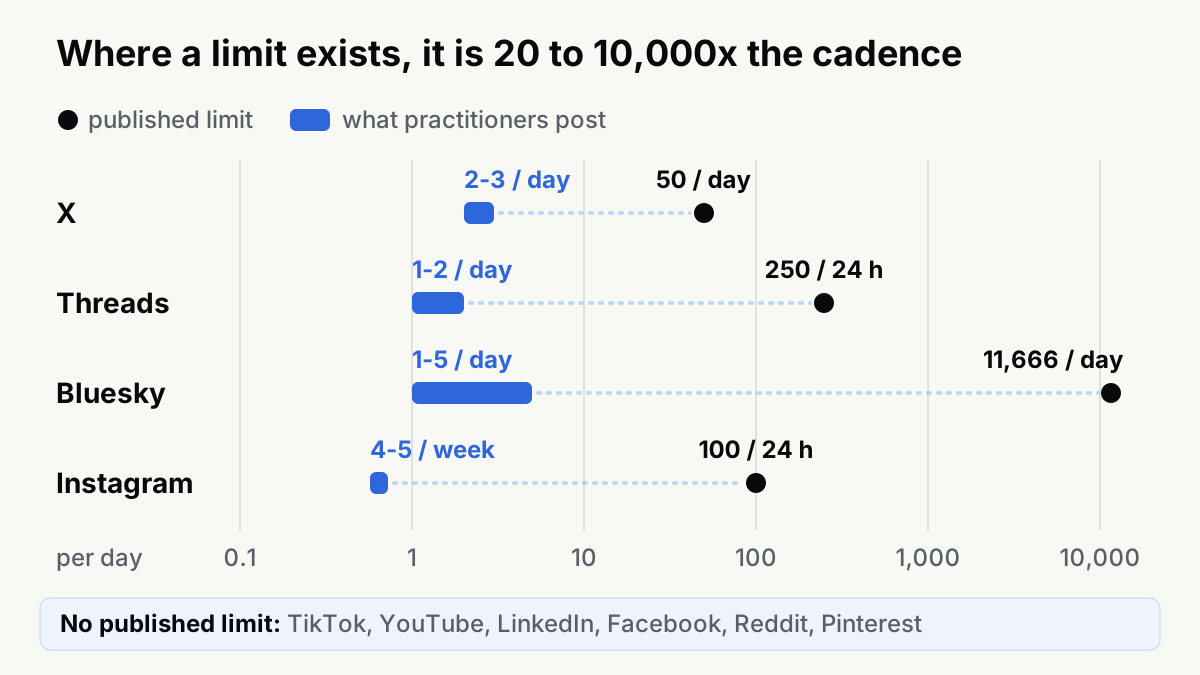
The table
The hard-limit column is the platform's own documentation, with the URL and the date we read it. Where it says not published, we looked and there is nothing; we are not filling the cell with a number from a vendor blog. The cadence column is practitioner consensus, which is a weaker kind of claim and is labelled as one everywhere it appears.
| Platform | Published hard limit | Source, retrieved 2026-09-21 | Practitioner cadence |
|---|---|---|---|
| X | 50 original posts + 200 replies / day (unverified accounts); 500 DMs/day; 400 follows/day | help.x.com | 2-3 originals/day, plus 10-20 replies |
| 100 API-published posts per rolling 24 h. In-app: not published | developers.facebook.com | 4-5 posts/week, at least 4 Reels/week | |
| Threads | 250 API-published posts and 1,000 replies per rolling 24 h | developers.facebook.com | 1-2 originals/day, replies uncapped |
| LinkedIn (member) | Not published. API: "Standard rate limits are not published in documentation" | learn.microsoft.com | 2-5 posts/week, never two inside 18 h |
| LinkedIn (page) | Not published | linkedin.com/help confirms invitation limits exist without a number | 2-4 posts/week |
| TikTok | Not published for posting. API: 6 requests/minute per user token on Direct Post | developers.tiktok.com | 1/day, 2/day once reach is stable |
| YouTube | A 24-hour upload cap exists; the number is not published. "Limits may vary by country/region or channel history" | support.google.com | 2-10 videos/month in most niches; Shorts higher |
| Facebook Page | Not published as a post count. Graph API app budget: 200 x number of users, per hour | developers.facebook.com | 4-5/week (3-4 Reels + 1-2 feed) + daily Stories |
| No posting cap published. Data API: 100 queries per minute per OAuth client id | support.reddithelp.com | No cadence target; keep promotion under 1 in 10 | |
| Bluesky | 5,000 points/hour and 35,000 points/day; a create costs 3 points, so at most 1,666 records/hour and 11,666/day | bsky.network | Several a day is normal; 1-5 originals |
| Not published as pins/day. API: 1,000 requests/day on trial access, 100/second per user on standard | developers.pinterest.com | 1-5 fresh pins/day; start at 1-3 on a new account |
Bluesky's documentation is the only one written like an engineer wrote it for another engineer, and it is worth reading the sentence it ends on: "These limits shouldn't affect typical Bluesky users! They won't affect the majority of developers either. But they will affect prolific bots, such as the ones that follow every other account or like every post on the network." That is what every one of these numbers is for. None of them is a cadence recommendation.
What "not published" hides
Six rows in that table are blank on purpose, and each one is blank for its own reason.
LinkedIn is the most explicit about being unhelpful. Its invitation-limit page says a restriction "typically lasts one week", that "withdrawing pending invitations will not remove the restriction", and that "LinkedIn Support cannot disclose the type or reason for the restriction." The number everyone quotes, 100 invitations a week rising to 200, appears nowhere in LinkedIn's own material. The claim that a high Social Selling Index raises that ceiling is also unsourced, which we go into in the SSI note.
YouTube confirms the cap and withholds the number in the same paragraph: "we limit how many videos a channel can upload in a 24-hour period across desktop, mobile, and YouTube API. Limits may vary by country/region or channel history." So the limit is not a constant, it is a function of your standing. That sentence is more informative than a number would be.
TikTok publishes API request rates and nothing about how many videos a human may post. Facebook publishes an app-level call budget that scales with your app's own daily active users, which is a developer quota and not a page posting limit. Reddit publishes a query-per-minute figure for data access and nothing about submissions, because on Reddit the constraint is per-subreddit rules and the spam filter, not an account cap. Pinterest publishes request quotas only.
The pattern is consistent and worth naming: platforms publish limits for machines and withhold limits for people. Anything that reads like a posting cap for a human is either from a developer doc or from a vendor blog guessing.
Why "more posts" backfires on a new account
The hard limits are so far above any sensible cadence that they are never your constraint. Something else is, and it is the same mechanism on every ranked feed.
Each post is tested on a small cohort first. New accounts have no interest signal, so the first posts are tested against a generic audience and underperform until the recommender works out who you are for. That test audience is a fixed, small pool. Post twice in a day and your second post is tested on roughly the people your first one just reached. You did not double your at-bats; you split them. On LinkedIn this is explicit in the product: an author-diversity reranker scales down a second post from the same author inside one viewer session, so the second post of the day is mechanically handicapped, not just unlucky. On TikTok the equivalent is splitting the seed cohort that your best video needed whole.
Repetition trips a different system entirely. Recycled, near-duplicate and low-substance posts are now demoted by name. LinkedIn's March 2026 feed announcement says it is "reducing recycled and click-driven posts"; the originality rules on YouTube, TikTok and Instagram operate at the account level rather than per post, which is the part people miss, and which we cover in unoriginal content rules. Volume is the fastest way to run out of genuinely original things to say, and the penalty lands on the account, not on the one weak post.
Zero views on a new account is usually the cold-start test, not a ban. If that is why you are here, the distinction matters a lot and we take it apart in TikTok 0 views on a new account and, more generally, in what is a shadowban.

The two readers of this page
Almost everything written about posting limits is written for one reader and read by another. It is worth separating them out loud.
Reader A: a founder with one real account. Every number in the table above is irrelevant to you. You will never send 50 posts in a day. Your constraints are attention, originality and the cold-start test. The right move is the low end of the cadence column and consistency inside one topic, and the only limit on this page you might realistically meet is LinkedIn's undocumented invitation ceiling.
Reader B: an operator running many accounts. The hard limits are your operating envelope, and they are per account, so they do not aggregate against you; the app-level budgets do. X's 10,000 posts per 24 hours is per app, not per account; Facebook's call budget scales with your app's users; Bluesky's relay caps new PDS instances at 100 accounts by default. That last one is the tell: Bluesky sized its defaults around the difference between a person and a fleet, and wrote it down.
We are not reader B, and we will say plainly that the well-known advice on this topic, residential proxies, per-account browser fingerprints, two-hour action spacing, drip schedules, is reader-B advice. For a founder with one genuine account it is inert at best. The one part of it that actively hurts reader A is the automation software itself: LinkedIn says it takes action against "unauthorized third-party tools", and that is a real risk you take on for a benefit you do not need. What a warmed account actually costs, and who buys them, is its own subject: what a warmed TikTok account costs.
A starting week
This is the cadence we would run on a brand-new account for the first month. It is the low end of every practitioner band, because a new account's problem is never volume.
| Platform | Week 1 | Notes |
|---|---|---|
| X | 1 original/day + 10 replies/day | Replies are the cold-start engine; they do not compete with your originals |
| 3 posts, at least 2 Reels | Reels are where non-followers come from; feed posts barely leave the graph | |
| Threads | 1 original/day + 5-10 replies | Connect the Instagram account first; that graph is the biggest asset you have |
| 2 posts, 3+ days apart | Plus one substantive comment a day on a larger in-lane post | |
| TikTok | 1/day, same format all week | Read completion rate, not views. Kill the format that does not hold |
| YouTube | 3 Shorts | Each is a cheap independent test; long-form only after one format retains |
| Facebook Page | 2 Reels + 1 feed post | Reels are the only thing that escapes a 50-follower page |
| 0 posts, 10-15 comments | Verify your email first; comment karma and account age gate most subreddits | |
| Bluesky | 1-2/day + replies | Getting into a niche starter pack is the growth mechanic, and it follows being visible |
| 1-3 fresh pins/day | Claim the domain first; expect near-zero traffic for two to three months |
Two things to notice about that table. Reddit's week-one row has no posts in it, because on Reddit the account has to earn the right to post before posting is useful, which we go through in Reddit karma and CQS. And nothing in the table is near a published limit, anywhere, by a factor of at least twenty.
About the dates
Every number here carries the date we read the page, because these move. X changed its own post cap and left a contradicting sentence further down the same help page, which we untangle in X rate limit exceeded. Instagram's publishing cap and Threads' 250 are the kind of figure that gets raised quietly. We re-check this table because our own publishing engine breaks when these numbers move, which is a better incentive than an editorial calendar. If a cell here is stale, the date in the header is the first thing that will tell you.
If a platform has shown you an actual restriction rather than a rate limit, that is a different diagnosis: start at account restricted: what platforms tell you.
Questions
- How many TikToks should I post a day?
- One, until the account has two weeks of stable reach, then two. TikTok publishes no daily posting limit. The reason to stay low is self-competition: each video is tested on its own small cohort, and stacking uploads splits the audience your best video needed.
- How many tweets per day is too many?
- X's published cap is 50 original posts a day for unverified accounts, but the useful ceiling is far lower. Two to three originals plus replies is the practitioner band, because the ranker scales down your second and third post to the same reader in one session.
- How often should I post on social media?
- There is no cross-platform answer, because the platforms differ by an order of magnitude: two to five times a week on LinkedIn, four to five a week on Instagram, once or twice a day on TikTok and Threads. Consistency in one topic beats volume on every platform we publish to.
- What is the LinkedIn weekly invitation limit?
- LinkedIn does not publish a number. Its help page confirms limits exist, says a restriction typically lasts one week, and states that Support cannot disclose the type or reason for the restriction (retrieved 2026-09-21). The widely quoted 100 or 200 per week figures have no primary source.
- Does posting more often get you more reach?
- Not on a new account. Ranked feeds test each post on a small cohort, and two posts a day compete for the same cohort. Duplicate or near-duplicate posts also risk the unoriginal-content rules, which are enforced at the account level rather than per post.