
№ 005Account standing8 minTal Weiss
LinkedIn SSI score: what it is, and why it is not your reach
Your LinkedIn SSI score is a Sales Navigator diagnostic LinkedIn is retiring, not a feed input. Here is what actually gates distribution, with the sources.

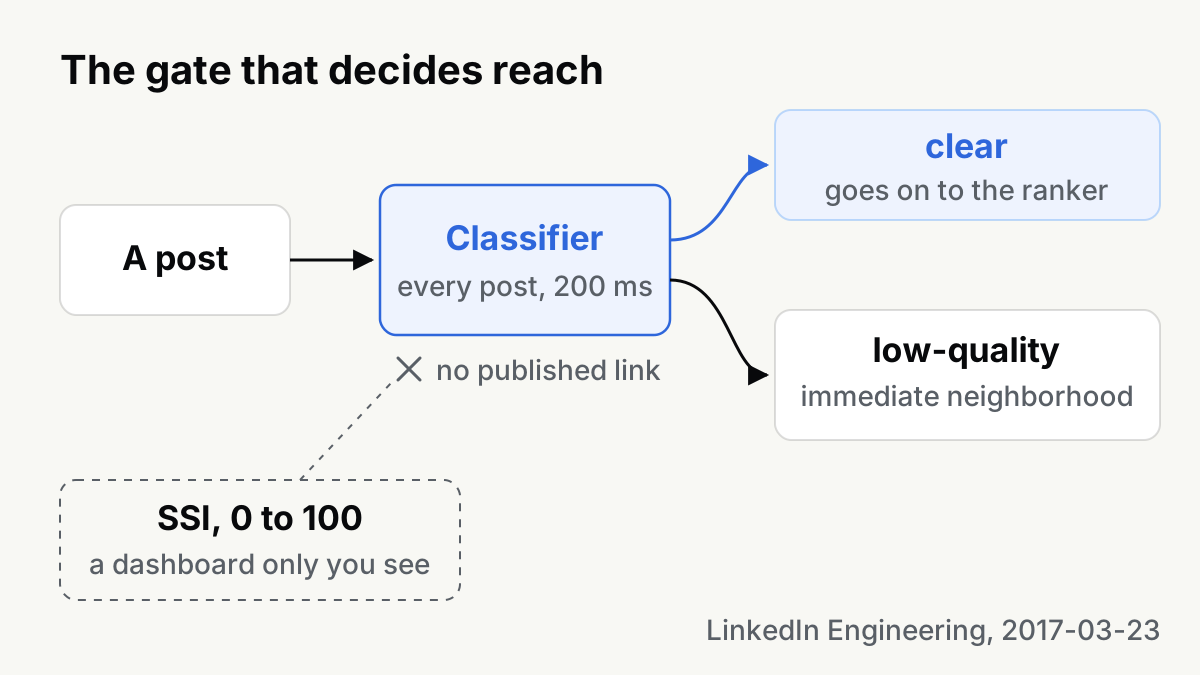
Short answer. The LinkedIn SSI score is a 0-100 number on a Sales Navigator page. LinkedIn's own page for it is now titled "From SSI to AI" and states that the score "no longer accurately reflects the modern sales environment" (business.linkedin.com/sell/resources/SSI, retrieved 2026-09-21). It is not an input to the feed. Distribution is decided somewhere else entirely: a classifier that labels every post spam, low-quality or clear before ranking begins, and a low-quality label restricts a post "to the immediate neighborhood of the poster."
That is the whole answer. The rest of this note is the evidence, and what to do with it.
- 0-100
- the SSI range, with no published pass mark
- LinkedIn, SSI page
- 200 ms
- for the text classifier to label a post
- LinkedIn Engineering, 2017
- 1 week
- a typical invitation-limit restriction lasts
- LinkedIn Help Center
- 0
- primary sources tying SSI to reach
- read 2026-09-21
What SSI is
LinkedIn built the Social Selling Index as a scorecard for salespeople. Its current description, verbatim:
LinkedIn developed the Social Selling Index (SSI) score as a benchmark to measure how effectively a salesperson uses social media for social selling, helping them improve performance.
It's a metric from 0 to 100 that indicates how well social sellers establish a professional brand, find the right prospects, engage with key insights, and build relationships on LinkedIn. It allowed LinkedIn users to compare their efforts to competitors and others in their network.
Note the tense in that last sentence. It is LinkedIn's page, retrieved today, describing its own live product in the past tense.
The four things in that sentence are the four elements the dashboard breaks the score into: establish your professional brand, find the right people, engage with insights, build relationships. You can read your own score free at linkedin.com/sales/ssi without a Sales Navigator subscription. Signed out, that page renders nothing at all, which we checked today, so nobody writing about SSI can show you the dashboard without showing you their own account.
What a "good" SSI is
LinkedIn does not say. There is no published band, no pass mark, no "70 is good" anywhere in LinkedIn's own material. What the dashboard gives you instead is two percentile ranks: where you sit against your industry, and where you sit against your own network. Those are relative positions, not grades, and they move when other people move.
Every article that tells you 70+ is good, or 75 is excellent, is repeating other articles. We looked for a primary source for that number and did not find one. If you want a number to manage, this is not it.
Why SSI is being retired
LinkedIn's reasoning is on the page, and it is unusually blunt for a company talking about its own metric:
A high SSI score doesn't always represent the efficacy of a sales person or correlate with measurable sales outcomes. Plus, the time and effort needed for high SSI scores can distract people from closing deals and building deep customer relationships.
And, further down, under the heading "Redefining sales success with AI solutions":
Some sales leaders and sellers may be reluctant to abandon SSI scores as a performance measure because it feels safe and familiar.
The page's entire argument is that sellers should stop optimising the number and use Sales Navigator's AI tooling instead. That is a product pitch, and we should read it as one. But a company arguing that its own famous score does not correlate with outcomes is still the strongest available statement about what the score is worth.
What actually decides your reach
LinkedIn has published how feed distribution works, on its engineering blog, and almost nobody writing about LinkedIn reach quotes it. From Strategies for Keeping the LinkedIn Feed Relevant (Rushi Bhatt and Bari Saltman, 2017-03-23, retrieved 2026-09-21):
Our online and nearline classifiers label every image, text, or long form post as "spam," "low-quality," or "clear" in near real time.
And the treatments, verbatim from the same post:
restricting content to the immediate neighborhood of the poster
limiting places where content can surface (e.g., it can be seen on a member's profile page but not on the feed)
That is the mechanism behind every "LinkedIn shadowban" article. It is not a ban and it is not secret. A post labelled low-quality is not ranked badly; its audience is capped, which is why the symptom is a post that lands on 80 impressions when your median is 900. The classifier is fast enough to run on everything: the same post reports "Support Vector Machine-based linear text classifiers classify content synchronously with a latency of 200 ms." A 2023 follow-up, Viral spam content detection at LinkedIn, adds the slower half, models that re-check content as it spreads: "These models are run on the platform every few hours."
Only what clears that gate reaches the ranker, which LinkedIn describes in LiRank as predicting two things per viewer and post: whether the viewer will read past a dwell threshold, and whether they will react, comment or share.
What the classifier reads
LinkedIn's March 2026 announcement, How LinkedIn Is Improving the Feed (2026-03-12, retrieved 2026-09-21), names what it demotes in plain words:
We're improving our systems to reduce repetitive, low-substance posts and engagement bait, such as "comment to agree" prompts or videos that don't match the text.
and:
we take action to stop behaviors that promote inauthentic engagement, including comment automation, engagement pods, and unauthorized third-party tools.
So the honest list of levers, ordered by how confident we are:
| Lever | Direction | Confidence |
|---|---|---|
| Engagement-bait phrasing ("comment YES", "agree?") | strongly negative | LinkedIn names it |
| Recycled or repetitive low-substance posts | strongly negative | LinkedIn names it |
| A video whose content does not match the caption | negative | LinkedIn names it |
| Engagement pods and comment automation | negative, and actioned | LinkedIn names it |
| External link in the body of the post | negative | direction only, magnitude unverified |
| Ten-plus hashtags | negative | practitioners report; no primary source |
| Your SSI score | none we can find | no source, either way |
We will not pretend the bottom two rows are as solid as the top four. The link penalty is consistent with a ranker that optimises for dwell on LinkedIn, and every practitioner we take seriously puts the URL in the first comment, but LinkedIn has never published a number for it. The hashtag ceiling is folklore with a plausible mechanism behind it.
What this means if you have one real account
You are a founder with one LinkedIn profile you actually use. Then:
- Stop reporting SSI. It is a free mirror of your own selling behaviour and it is fine to glance at. It is not a KPI, and LinkedIn is telling you so on its own page.
- Watch impressions against your own median instead. One post at a tenth of your rolling median is the signal that matters. That is the classifier, not a ban, and it is per-post. There is no appeal and no form. The only recovery LinkedIn leaves you is the next post.
- Pick one lane and stay in it. The retrieval side of the feed routes posts to people by topic, not by who follows you, so an off-topic post has no audience to be routed to. This is the single biggest lever we see and it is invisible in every score.
- Put the link in the first comment, write for a reader rather than for a reaction, and skip the bait line at the end.
What this means if you run many accounts
Different reader, different advice, and most of what is written about LinkedIn "safety" is written for you rather than for the founder above. If you operate dozens of profiles, your constraint is not the feed classifier at all. It is LinkedIn's automation enforcement, which the March 2026 announcement says explicitly is aimed at "unauthorized third-party tools", and the invitation limits.
On those limits: LinkedIn publishes that they exist and refuses to publish the number. From Invitation limit reached (retrieved 2026-09-21): a restriction "typically lasts one week", "withdrawing pending invitations will not remove the restriction", and "LinkedIn Support cannot disclose the type or reason for the restriction." There is a widely repeated claim that a high SSI raises your weekly invitation ceiling from 100 to 200. We could not find that anywhere in LinkedIn's own material, so we are not going to repeat it as fact. It is the one place SSI is rumoured to have teeth, and the rumour is unsourced.
The same pattern holds on the developer side. Microsoft's LinkedIn API documentation states it directly: "Standard rate limits are not published in documentation" (API rate limits, retrieved 2026-09-21). You discover your own quota by calling the endpoint and reading the Analytics tab. For the wider picture of who publishes what, we put every platform's real numbers side by side in posts per day limits by platform.
What to do this week
- Open linkedin.com/sales/ssi once. Note the number. Do not put it in a dashboard.
- Export your last 20 posts' impressions and take the median. That median is your baseline; a post far under it is the one to read against the list above.
- Read the three worst posts against the list above. Look first for the two shapes LinkedIn names: a generic post with no specific point of view, and a post outside the lane the account is known for.
- Pick the lane. Post two or three times a week inside it, and not back to back: LinkedIn's feed papers describe a reranker that scales down repeated posts from one author in the same feed session.
If reach dropped and you want the general version of this diagnosis rather than the LinkedIn one, start at what is a shadowban, or at account restricted: what platforms tell you if LinkedIn has shown you an actual restriction notice.
We run a publishing engine across nine platforms, which is why we had to read these pages closely rather than trust the folklore. The number LinkedIn shows you is not the number LinkedIn uses.
Questions
- What is a good LinkedIn SSI score?
- LinkedIn has never published a band. Its public SSI page gives only the 0-100 range and no threshold, and the dashboard shows you percentile rank against your industry and your network rather than a pass mark. Any article quoting 70 or 75 as the good score is quoting other articles.
- Does a higher SSI score increase your LinkedIn reach?
- No evidence says so. LinkedIn's own engineering writing describes feed distribution as a spam / low-quality / clear classifier followed by a ranker, and SSI appears in neither. SSI lives on a Sales Navigator page and is visible only to you.
- Is LinkedIn getting rid of the Social Selling Index?
- LinkedIn's SSI page is now titled "From SSI to AI" and says the score "no longer accurately reflects the modern sales environment" and that "a high SSI score doesn't always represent the efficacy of a sales person" (retrieved 2026-09-21). The dashboard still loads, but LinkedIn is steering sellers off it.
- Where do I check my SSI score?
- linkedin.com/sales/ssi, signed in. It is free and does not require a Sales Navigator subscription. Signed out the page renders empty, which is why no public article can screenshot your own bands.
- If SSI does not move reach, what does?
- Whether a post clears the pre-rank quality classifier, and then whether it earns long dwell and comments. In practice: original text, no engagement-bait phrasing, no link dumped in the body, few hashtags, and one topic you post about consistently.