
№ 012Account standing11 minTal Weiss
What a warmed TikTok account costs, from 1,520 live listings
A warmed TikTok account is $25 one-time or $100 a month. Aged Instagram accounts start at $0.17. What the market charges, why accounts die, and who is liable.
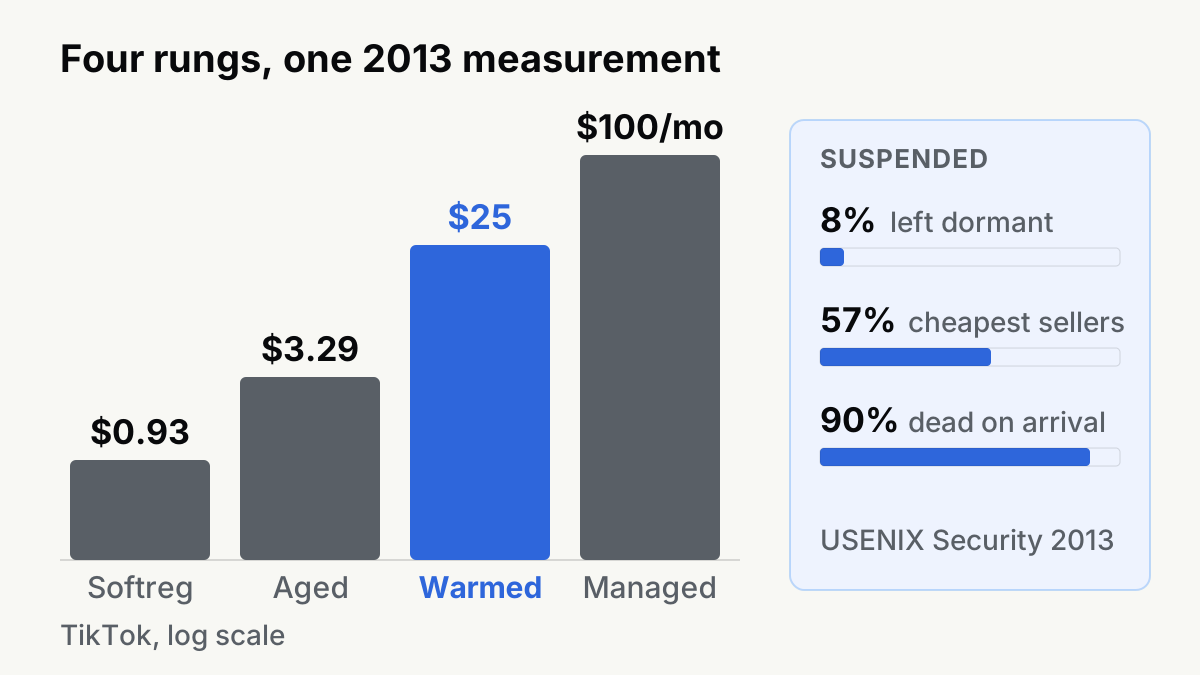
A warmed TikTok account costs $25 one-time if you take the credentials, or $100 a month plus $1.50 a post if you do not. Underneath that sits a commodity market where a freshly registered TikTok account is $0.14 and an aged one has a median price of $3.29. We parsed six platform catalogues on one marketplace on 2026-09-21: 6,473 listings, of which 1,520 were in stock, covering 422,523 individual accounts. The market is real, it is cheap, and the only rigorous public measurement of how long a bought account survives is from 2013. Everything newer is a vendor claim.
- $25
- warmed TikTok account, credentials handed over
- TokWarm, live 2026-09-21
- $100/mo
- managed account, the vendor keeps the credentials
- Fastlane, updated 2026-09-03
- $31/mo
- about, to run one bought account yourself
- Bright Data and GeeLark pricing
- 90%
- of 14,067 bought accounts dead on arrival
- Thomas et al., USENIX Security 2013
The commodity market, priced today
AccsMarket is the deepest of the bulk marketplaces. We parsed its six catalogues on 2026-09-21 and counted only listings that were actually in stock. Nearly two thirds of the TikTok rows show zero units, and some of those carry a $0.01 placeholder price that would flatter any average.
| Platform, tier | In-stock listings | Price range | Median | Units in stock |
|---|---|---|---|---|
| TikTok, softreg | 98 | $0.14 - $5.55 | $0.93 | 9,551 |
| TikTok, aged | 58 | $0.30 - $37.00 | $3.29 | 9,108 |
| TikTok, with followers | 140 | $1.11 - $481.00 | $5.87 | 2,445 |
| Instagram, softreg | 194 | $0.09 - $3.70 | $1.39 | 106,042 |
| Instagram, aged | 63 | $0.17 - $27.75 | $1.44 | 73,876 |
| X, aged | 107 | $0.36 - $92.50 | $1.83 | 75,145 |
| LinkedIn, aged | 46 | $1.67 - $555.00 | $148.00 | 2,249 |
| Reddit, boosted karma | 49 | $1.00 - $930.55 | $37.00 | 171 |
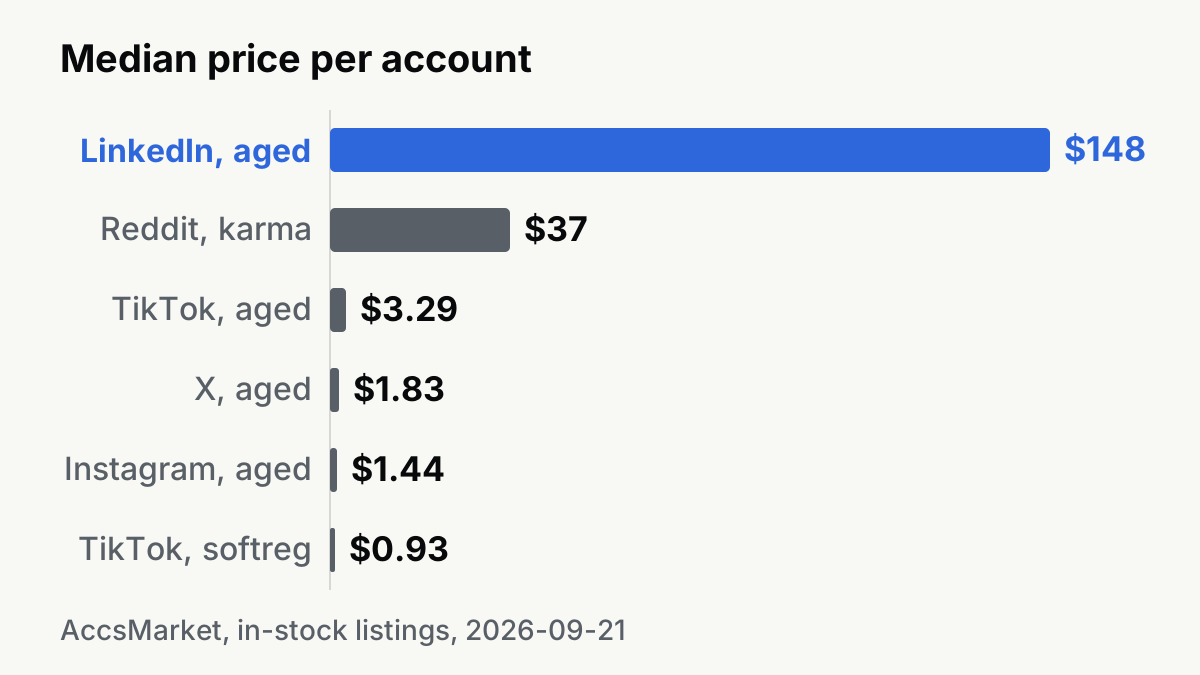
Two things are worth seeing here rather than being told.
The prices move, and everyone else's article is frozen. We priced the same catalogues thirteen days earlier, on 2026-09-08. TikTok softreg was unchanged at a $0.93 median. The aged X median went from $0.88 to $1.83, more than doubling in under a fortnight. Any page quoting a 2024 price for an account is quoting a number that has turned over several times since.
What you pay for is a registration fingerprint, not an audience. TikTok's aged tier costs three and a half times its fresh one, and LinkedIn's aged median is $148 against a $1.62 fresh one. What the price tracks is how hard the account was to register. And the follower tiers label themselves: 204 listings in the TikTok catalogue carry the word (bots) in their own description, as in "About 12 000 followers (bots)".
The word "warmed" appears nowhere in this marketplace's taxonomy. It sells registration date, follower count and profile completeness. Warming is sold as advice here, which is exactly the gap the 2026 vendors moved into.
What actually arrives
A text file. Login, password, the email and its password, a 2FA key, backup codes, Base64 cookies and a user agent. Downloadable for thirty days, then deleted. The store rules (retrieved 2026-09-21) are more informative than the catalogue, and three clauses carry the whole risk:
"The full validity of the account (within 48 hours after the purchase)"
"The responsibility shifts to the buyer after the purchase is made"
"The client will change passwords for the accounts and will independently take care of their security"
That last one is the tell. Until you rotate the password, the seller still holds a working recovery path to the account you are about to build a distribution channel on.
The price is not the price
The same rules page voids the guarantee if you log in from your home IP, a VPN, TOR, a virtual machine or server, a shared or public proxy, an IPv6 proxy, or - notably - a residential or ISP proxy. What it requires instead:
"1 legal private IPv4 proxy server and 1 new device (new UserAgent, cookie, specialized program) MUST be used for 1 account."
So the real unit cost is the account plus a dedicated IP plus a distinct device, per account, per month. A private datacentre IP starts at $0.90 and an ISP one at $1.30 on Bright Data's pricing page (retrieved 2026-09-21). A cloud Android phone was $29.90 per device per month when we priced GeeLark on 2026-09-08, the vendor this marketplace names by name.
About $31 per account per month, before content. Hold that number: it is more than the warmed tier charges to do the whole thing for you.
The warmed tier, and what it quietly admits
TokWarm (live 2026-09-21) is the clearest statement of the 2026 product. $25 one-time for a five-day warm-up, $89 for a seventeen-day programme, $12 a week if you want a person to post for you afterwards. The description is specific: "A vetted worker on a real phone runs the account daily - scrolling, following, and engaging in your niche. No bots, no scripts," with daily screenshot proof. Credentials are handed over: "The account is yours, forever." The homepage claims 12,000 accounts warmed. SuperWarm runs a near-identical programme shape.
Fastlane sells the other shape, at $100 per account per month plus $1.50 per post, with an active subscription required. The page was updated 2026-09-03. Its copy is carefully built: accounts are "created from scratch by a real person on a real phone in the country you want to target", "warmed for 5 days", "no emulators, no farms". Its own FAQ question is "Do I own the account?" and the answer never says you receive the credentials. It says the account is "created for you, connected to your Fastlane workspace, and managed inside Fastlane".
That difference is the product. One sells you an asset. The other rents you a channel it can switch off.
And the commodity marketplace, which sells no warming at all, gives the case away in its own FAQ answer on fresh versus aged accounts (captured 2026-09-08; the question is still on the page today): "it is safer to warm up any account regardless of age... If fresh accounts are warmed up properly, in time they can be as much as effective as aged accounts." The seller of aged accounts is telling you the age premium is optional.

Why they die: the cohort, not the account
The best measurement ever made of this market is Thomas, McCoy, Grier, Kolcz and Paxson, "Trafficking Fraudulent Accounts", USENIX Security 2013. They bought accounts from 27 merchants over ten months and then built a classifier on registration-time fingerprints - naming conventions, IP pools, email patterns, CAPTCHA behaviour - rather than on anything the accounts did afterwards.
"With Twitter's cooperation, we disable 95% of all fraudulent accounts registered by the merchants we track, including those previously sold but not yet suspended for spamming."
"Of 14,067 accounts we purchased, 90% were suspended on arrival."
Two weeks later the market had partly recovered and only 54% of a fresh batch were dead on arrival. The survival split is the counter-intuitive part:
"Of the dormant accounts we purchase, only 8% are eventually detected and suspended."
Used accounts fared very differently by seller: 57% suspended for the cheapest sellers, 5% for professional storefronts. Sitting on an account is nearly free; using it is where the risk is. The paper also explains the pricing table above: phone-verified Facebook and Gmail accounts cost "up to 150x" their non-verified Twitter counterparts, and accounts are stockpiled for a median of 31 days before sale, so "aged" often just means shelved.
The mechanism is what transfers to 2026, not the percentages. You are not suspended for what your account did. You are suspended in a batch, because a classifier clustered your account with the thousands of siblings registered from the same pool. No amount of good behaviour after purchase removes a registration fingerprint. We looked hard for a newer number and found none: not one vendor in this market publishes a survival rate, and every 2026 figure in circulation traces back to marketing copy.
What the platforms' own terms say
All fetched 2026-09-21.
| Platform | The clause | Creating an account for a client? |
|---|---|---|
| "You can't sell, license, or purchase any account... This includes attempts to buy, sell, or transfer any aspect of your account (including your username)" | Allowed with a carve-out: "you can't create an account for someone else unless you have their express permission" | |
| "Rent, lease, loan, trade, sell/re-sell or otherwise monetize the Services" | Banned outright: "create a Member profile for anyone other than yourself (a real person)" | |
| "You will not license, sell, or transfer your Account without our prior written approval." | Not addressed | |
| TikTok | Not in the terms; in the guidelines: "we don't allow accounts that mislead or try to manipulate our platform, or the trade of services that artificially boost engagement or trick the recommendation system" | Not addressed. Stated remedy: "Ban your account. Ban additional or new accounts you create." |
| X | "Attempts to sell, buy, or solicit other forms of payment in exchange for usernames are also violations and may result in permanent account suspension." | Managing accounts for a third party is allowed |
Two live notes. TikTok's guidelines page carries a banner saying they are replaced on 2026-09-24, three days after we read it, so anything written about TikTok policy this month has a very short shelf life. And Instagram's carve-out sentence is doing more work than any other sentence in this table: the entire managed-account tier rests on the customer's order counting as "express permission", and that carve-out does not exist on LinkedIn or X, which is precisely why the vendors sell TikTok and Instagram and nothing else.
X now sells handles itself
Worth knowing before you pay a broker. X runs an official Handle Marketplace (retrieved 2026-09-21) where eligible Premium subscribers can request inactive handles, sometimes for "a transfer fee". The terms are explicit about what you get: "a limited, revocable, and non-transferable license to use the handle", and "X owns all handles, and may reclaim them anytime". Eligibility requires an account older than three months showing "clear signs of authentic, ongoing content creation".
The only sanctioned handle market on that platform is the platform's, it is a licence rather than a sale, and it gates on exactly the account standing you would have had to build anyway.
Who is actually liable
The FTC rule is about followers, not accounts. 16 CFR 465.8 bans selling or buying "fake indicators of social media influence". The rule defines indicators as metrics - followers, subscribers, views, likes - and in the final rule the Commission said so directly when it declined to extend the rule:
"It is not the creation of the bot or fake account, itself, that the rule makes illegal, but the use of the bot or fake account to follow another user, watch another user's videos, or create other fake indicia of social media influence."
So a zero-follower warmed account sits outside § 465.8. An account sold "with followers (bots)" sits squarely inside it, and § 465.8(b) makes the buyer liable as well as the seller. Civil penalties run to five figures per violation. This is not legal advice; it is what the rule says.
The constraint that actually binds is the payment rail. Stripe's restricted businesses list names "Sales of online traffic or engagement" (retrieved 2026-09-21). Lemon Squeezy prohibits services of any kind and anything its processing partners restrict. That is why the commodity market refunds only to Perfect Money, Advcash, WebMoney and Litecoin: not a preference for crypto, but the absence of an alternative. And the downside is not a fine. It is a frozen balance and a terminated account applied to your whole company, including the revenue that had nothing to do with it.
If you have one real brand account
None of this is for you, and the arithmetic says so. A warmed account is a channel with no followers, no history you can point to and no recovery path you fully control. Your own account already has the one thing the market cannot sell: a registration fingerprint that belongs to a real person in a real place. The reason a new account gets no reach is not that it lacks age; it is that it has no signal yet, and five days of a stranger scrolling in your niche is not signal about you. Our per-platform notes on why a new TikTok account gets zero views and what a shadowban actually is cover what does move.
If you are running many accounts
Then this market is your supply chain, and the honest summary is short. Rungs one and two are priced in cents, which tells you what they are worth. Rung three costs less than running the infrastructure yourself. Rung four is the only tier where somebody else carries the operational risk, and it is also the tier where you never hold the credentials. Every rung violates the receiving platform's terms in some way, and the enforcement pattern that has been documented is a cohort sweep, not a per-account judgement, so your diversification is worth less than it looks if the accounts were made the same way. On Reddit specifically, the boosted-karma tier is on sale at a $37 median and will still be read by a score built on account history and network signals, not on the karma number.
Why we do not sell this
We publish across nine platforms for founders, and warmed accounts would be an obvious upsell. We do not offer them, for three reasons that are all commercial rather than moral. The rails would not take the money. The one measurement that exists says a purchased cohort dies together rather than individually, which makes it a product we could not support. And a customer whose distribution sits on credentials they do not hold is a customer whose business we can break by accident.
What we are building toward instead is account standing as the thing to engineer: one post to one community, original content, the same account for years, and every eligibility rule read before publishing rather than after a removal. The other notes in this series are that reading, including the rules we broke ourselves.
We are ShapelessAI: an agentic content team that researches, writes, designs and publishes to nine platforms for founders.
Questions
- How much does a warmed TikTok account cost?
- Two prices, for two different products. Vendors who hand over the credentials charge $25 one-time for a five-day warm-up and $89 for a seventeen-day programme. A vendor who keeps the credentials and operates the account inside its own product charges $100 per account per month plus $1.50 per post, on top of a subscription. Both were live on 2026-09-21.
- How much do aged Instagram accounts cost?
- On the deepest commodity marketplace, parsed 2026-09-21: aged Instagram accounts ran $0.17 to $27.75 with a median of $1.44 across 63 in-stock listings, and freshly registered ones started at $0.09. Accounts with followers, which the listings themselves usually label as bots, had a median of $4.63.
- Do bought social accounts get banned?
- Nobody has published a credible survival rate since 2013. The one rigorous measurement, by Thomas et al. at USENIX Security, found 8% of bought accounts left dormant were eventually suspended, 5% when used carefully, and 57% when bought from the cheapest sellers. After one registration-time classifier ran, 90% of 14,067 freshly purchased accounts were dead on arrival. The mechanism still holds; the numbers are thirteen years old.
- Is buying a social media account illegal?
- In the US, buying the account itself generally is not what the FTC's rule reaches. 16 CFR 465.8 covers fake indicators of influence, which the rule defines as metrics such as followers and views, and the Commission said in the final rule that creating a fake account is not itself what the rule makes illegal. Buying an account that comes with bot followers is a different matter, and the buyer is liable too. Every platform's own terms ban the transfer regardless.
- Can I sell warmed accounts as a business?
- Not on ordinary card rails. Stripe's restricted businesses list names "sales of online traffic or engagement" outright (retrieved 2026-09-21), and Lemon Squeezy prohibits both services in general and anything its processing partners restrict. That is why the commodity marketplaces refund only to Perfect Money, Advcash, WebMoney and Litecoin.